[…]
“Honestly. It must be a bit like that photograph of yours, the blow-up falsifies the context: you have to see things from a distance. Méfiez-vous des morceaux choisis.”
Antonio Tabucchi, Indian Nocturne1
“Something fantastic has happened. Those photographs in the park, fantastic! Somebody was trying to kill somebody else. I saved his life.”
Michelangelo Antonioni, Blow–Up2
A.
Two coordinates for the reader:
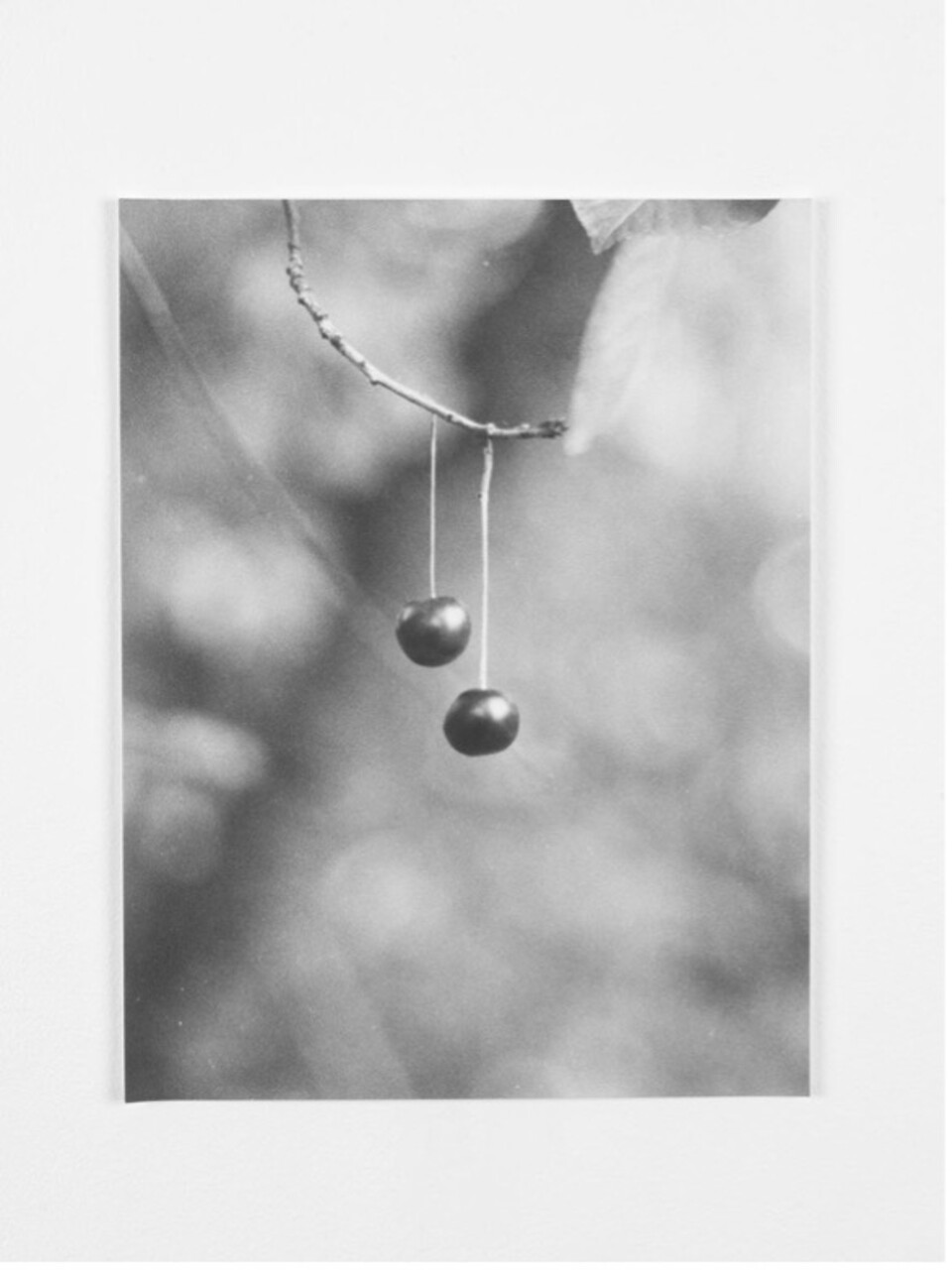
Jochen Lempert, Kirschen, 2019, © Jochen Lempert/VG Bild-Kunst, Bonn 2022. Courtesy BQ, Berlin und ProjecteSD, Barcelona
1.
“Beware of the chosen pieces!” (Or one could also intend “Beware of the cherry-picking”…)
Recommends the character in Antonio Tabucchi´s Indian Nocturne.
2.
As for the photographer in Blow-Up: he didn´t save anyone. Even though he thought so at first, it was a deception.
Blowing-up the pictures though, the photographer finds out “the fact”, something his bare eyes could not perceive at first. He stretches the image and in this very precise moment, it seems like the matter of the fact (that is the matter of the image) is at once more clear and more cloudy. The perceptible particles of all subjects seem to stay still, in a state of explosion, –at the beginning of it, one could say. In this very moment, while seeing less, while the contours between things blur in between the grains of the image, one can see better. Or can detect something new, something unexpected.
When looking carefully, it is possible to realize that everything one sees is made of the same substance. Should the viewers be willing to engage in a sort of myopic dance, in the space, in front of Jochen Lempert´s photographs, by going very far from and very close to the very large and the very tiny images shown in Portikus, they could calibrate their own sight, and play. Indeed, one could think about it as a danced game of gazing exercises.
B.
According to the dictionary the etymology of the word “coincidence” can be traced back to the 1600 ca. At that time its meaning was: “exact correspondence in substance and nature,” while in 1640 “coincidence” started to be intended first as “occurrence or existence during the same time”, and then as “a concurrence of events with no apparent connection, accidental or incidental agreement.”
For the purposes of this investigation, let´s keep in mind the first definition: “the exact correspondence in substance and nature.” In fact, it is no accident at all that the photographs here are so crucial both to their own constellations and to the exhibition space. No mediating devices, no glasses, no passepartouts, no frames are to be seen when entering Portikus. The photographs are directly placed on the walls. Bare, they become part of the architecture itself.
When talking about the difference between “choice” and “decision” during an exhibition tour curator Yasmil Raymond highlights that choice can be defined as an opportunity, ability to select, whilst decision is a conclusion, a judgement, a powerful resolution. “It is a cut” Raymond says, while cutting the air with the fingers as one does with scissors. SNIP. The metaphor falls perfectly into place when it comes to this photographic work. Jochen Lempert decides, therefore he cuts. For each show he goes into the exhibition space with a large selection of photographs from his archive, only then he decides which are the ones that are to be shown in these specific circumstances. Once the decision is taken, at that very moment he cuts the prints, on site. No ambiguity. The purposedly and carefully re-framed photographs thus turn into something new, they are now different from their companions in the artist´s archive. While being at once doubles and extraordinarily unique, in every exhibition the pictures become simultaneously part of a new constellation (the here and now) and of an on-going, ever growing one (connected to all other Lempert´s exhibitions past, present and future).
C.
When talking about the selection of photographs in one of the vitrines downstairs, Deborah Müller, co-curator of the exhibition, points out that Jochen Lempert has always been interested in the connection point between the trees and the earth. It is particularly exciting to wonder about the reasons why. In fact, thinking about it, it is a very specific liminal area for it is not really defined: it is not possible to perform a proper cut here. Plus, it is exactly where, through the trees, one can see air and earth showing their interconnectedness. Trees as beings that link the earth to the sun and the cosmos. They extend themselves deep down into the earth. What one sees it is just a part, a detail, apparently cut out from the rest of the context. They are indexes signaling that there is always something else that can be discovered out of the frame of the immediately visible.
D.
As in a sort of Warburgian Mnemosyne the photographs can be read, experienced, memorized in different orders and directions. On the upper floor they can be looked at dispersed at different heights vertically and horizontally; downstairs they are both on the wall, aligned at the same height or placed horizontally in four vitrines, to allow a book-like perspective. Eyes are invited to adjust to the change of scale, they cannot quite rest. Within a matrix of positions and sizes, the gaze proceeds and stops, goes back and forth again, for in the exhibitions there are many clues, and it often happens that one recognizes elements, pairs them with one´s own memory and with the newly shaped memories created by other exhibited pictures. It is a cross-reference game between details that look alike and bring the mind elsewhere, out of the frame. A travel in space and time amongst crops that constantly remind the viewer of something else.
Like cherries, one leads to the other, and one cannot stop eating them.
E.
Two cherries pair with the eyes of a frog and connect with the trees outside the windows. Then to the chessboard-like tree trunk. A picture of a leaf resembles a map of a city. And while the coral testifies that its shape is the outcome of the sea streams and external circumstances, the very same grains of all the prints, the very matter of the images let the viewers connect the dots. Everything seem and is the exact correspondence in substance and nature of something else. Or of everything else.
It´s at once a split second and all history together. A ladybug, a car, a console bracket, a detail of a painting, the window of a plane.
SNIP.
They overlap.